The Challenge
Make chronic shop-floor issues visible and easier to resolve
Since 2017, Al Dhafra Paper Manufacturing has converted waste paper into recycled test liner and fluting medium for the packaging industry in the UAE and internationally. The company produces 650 tons of recycled paper daily and places environmental and technical safety at the centre of its operating model.
With digital transformation high on the agenda and a desire to strengthen Lean thinking among staff, the company selected Presto to structure daily shop-floor challenges, improve visibility and create a stronger sense of urgency around performance.
Core Objectives
Build Lean thinking into daily execution
- Inculcate Lean and Kaizen-based thinking at all levels of the organisation.
- Create a stronger sense of urgency, ownership and purpose.
- Build a non-confrontational continuous improvement culture where issues, problems and waste are visible.
- Reduce time spent on excessive documentation, paperwork and communication.
- Solve problems earlier and act before they become chronic.
- Improve visibility into team-level roles and responsibilities and communicate expectations more efficiently.
The Approach
Connect issue management, KPI reporting and accountability
The engagement expanded the use of Presto around three practical opportunities: integrate the issue-management newsfeed into a company-wide operational problem-solving workflow, use KPI reporting to support long-term managerial governance, and identify additional Lean Six Sigma methods that could support operational excellence.
Together with Al Dhafra business leaders, the team also designed a multi-view project and issue-management Kanban. Users could move from a traditional project view to a multi-phase storyboard listing open issues by status and owner, while filtering by owner, RACI involvement, period, status, favourites and benefit type.
Immediate Results
Significant activity captured in less than three months
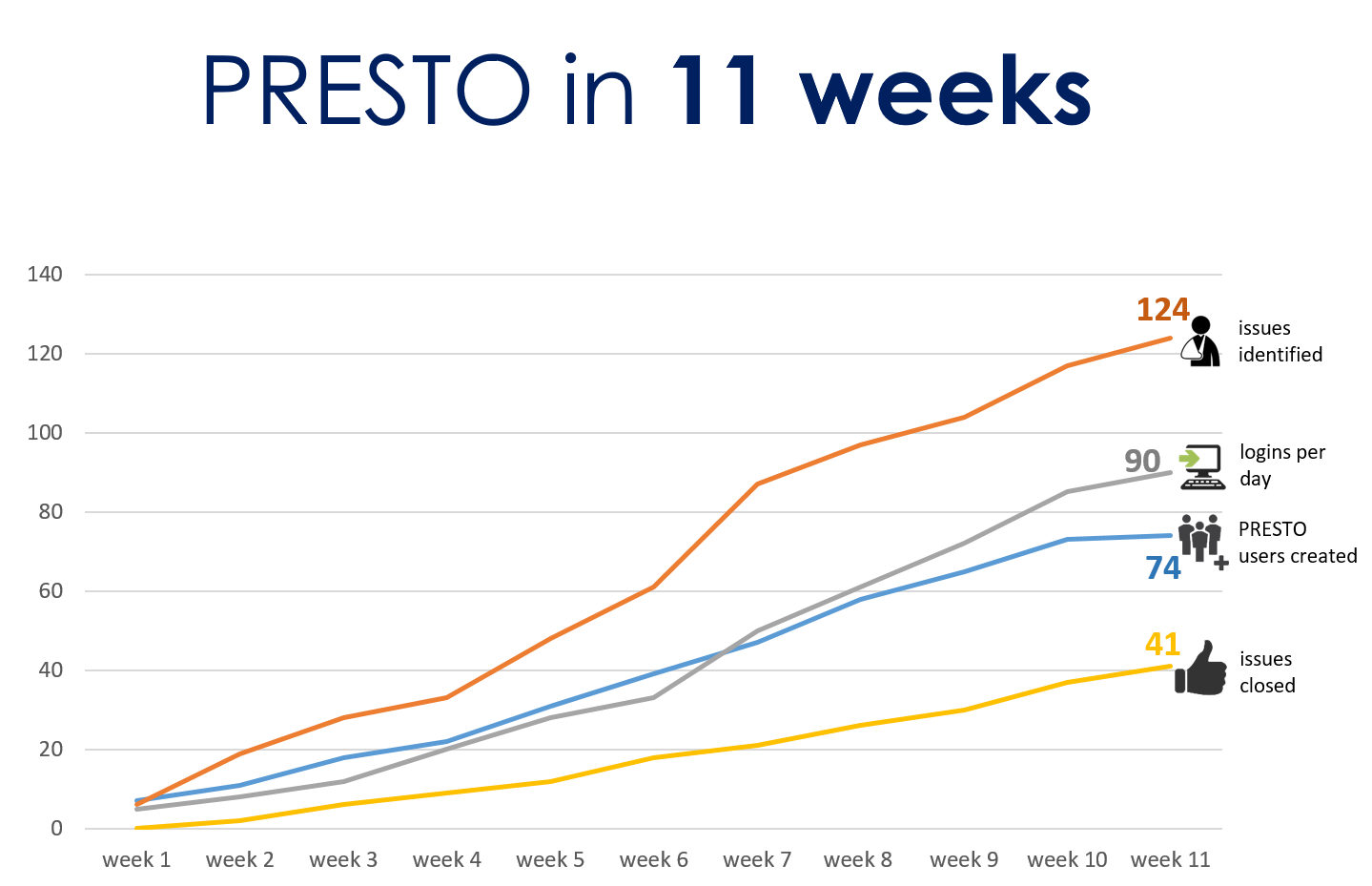
With a small internal project team, Al Dhafra recorded 25 hours per week saved on administrative activity, 158 issues opened, 920 actions and tasks identified, 74 issues closed and 531 actions and tasks completed.
In parallel, 84 teams were set up with corresponding roles and responsibilities, 641 employees were assigned roles, 100+ Presto super users were created and the platform reached 100+ logins per day.
The Presto Value Proposition
Give managers a faster way to see, prioritise and act
The issue-management newsfeed gave managers and problem solvers a simple place to review activity underway, outstanding tasks, comments and shared best practices. This helped teams stay current on issue-related activity without relying on fragmented follow-up.
Within a few weeks, the full Al Dhafra productivity KPI set had also been entered into Presto, changing the way the daily management meeting prioritised activity. Automatic alerts and email notifications were used with RACI assignments to reinforce ownership and urgency.
Senior management also gained a clearer view of shop-floor issues organised by category and could navigate across organisational levels. As the implementation expanded from Business Operations into Finance, Accounting, IT and Human Resources, role and responsibility management became increasingly useful for clarifying expectations.
Conclusion
From issue capture to a broader continuous improvement discipline
The original case study reports a stronger company-wide sense of urgency, ownership and purpose, supported by greater visibility into real-time issues affecting daily operations. As RACI logic became part of day-to-day problem solving, knowledge gaps became easier to identify and cross-training responsibilities became clearer.
Issue-management checklists created by subject matter experts could also be archived so that problem-resolution know-how was captured digitally and made available to others, strengthening the long-term continuous improvement model.